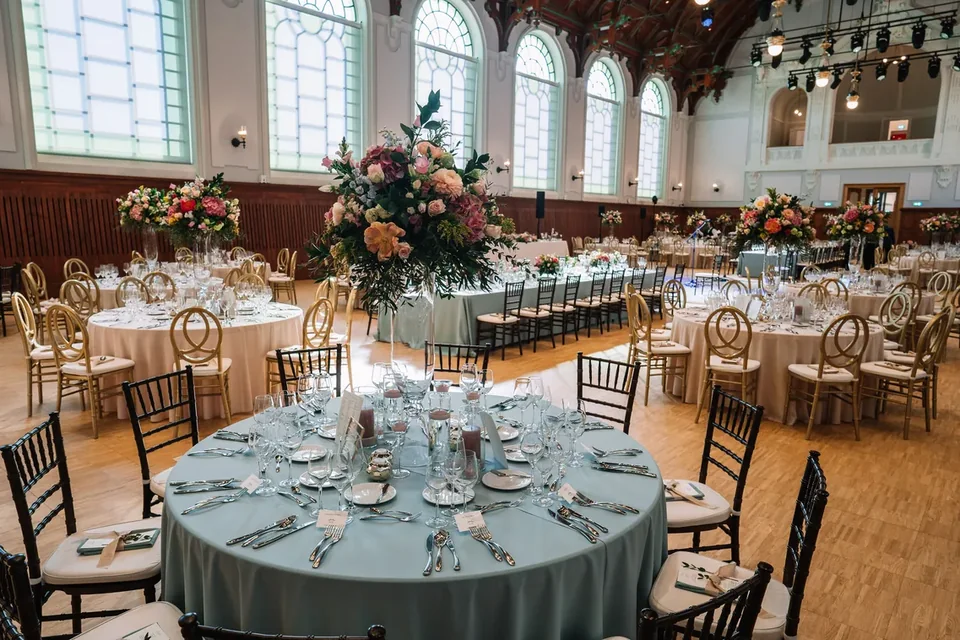
Royal Riding Hall gives a wedding its sense of occasion through architecture. A carved timber ceiling, coloured glass and galleries overlooking the hall establish a distinctive setting. In the Csikós Courtyard at Buda Castle, arrival and the discovery of the interior form a connected experience. The history of royal riding, the craftsmanship of reconstruction and the building’s present event use together make this a place with a story beyond its impressive scale.
- Distinctive feature
- Monumental hall in a historic setting
- Space
- 640 m² hall
- Guest numbers
- Confirmed around dinner, dance floor and stage
01
Hauszmann’s riding hall and its reconstruction
The National Hauszmann Programme dates the original Riding Hall’s construction to 1899–1902. Its account associates Alajos Hauszmann’s building with timber work by Károly Neuschloss and coloured windows from Miksa Róth’s workshop. Damaged in the Second World War, the hall was demolished in 1950.
The present building was recreated from historic documentation. A wedding here therefore occupies a reconstructed courtly setting: the materials and representative proportions of the turn of the twentieth century brought into present use. Reconstruction is as much a part of the venue’s story as its former equestrian purpose.
[2]02
Between the royal and musicians’ galleries
The palace district’s official account highlights the royal and musicians’ galleries, coloured glass and elaborate timber panelling. The interior unfolds at several levels: above the tables are the windows, the overlooking galleries and the details of the exposed roof structure.
This vertical composition is one of the keys to the hall’s ceremonial character. Flowers and lighting can connect most closely with the setting when the galleries and carved ceiling remain visible, allowing decoration to form a composition with the architecture already present.
[3]03
An internationally awarded roof in red and green slate
Várkapitányság’s November 2021 account records the roof’s victory in the metal-roof category at the International Federation for the Roofing Trade competition in Marburg. The hipped mansard and gabled roof incorporates red and green English natural slate, with finials, cupolas and windows articulating its shape.
This is an award for roof construction, rather than wedding services. Nevertheless, it says something specific about the setting: the richness of detail is apparent from the courtyard before entering beneath the timber ceiling. The roof is integral to the Riding Hall’s external silhouette.
[7]04
The craftsmanship behind the roof ornaments
In its Roof of the Year 2020 presentation, the Hungarian professional association ÉMSZ commends Péter Birghoffer’s sheet-metal and ornamental-metalwork design documentation for Royal Riding Hall. Its account identifies Horex Kft. as the roof contractor.
This adds a human dimension to the exterior. The roof ornaments are the result of specialist design and craft rather than anonymous decorative effects. Named contributors and documented workmanship give the building a more specific story, connecting the ceremonial appearance with the people and skills involved in making it.
[8]05
An oak floor that recalls the original purpose
Reconstruction architects KÖZTI worked under Ferenc Potzner. Their project description identifies archive drawings, photographs and art-historical research as the basis for recreating details.
The hall’s assembled oak flooring is removable. According to the architects, a twenty-centimetre layer of sand can be installed beneath it for equestrian events. This architectural provision retains a connection to the function behind the name. At a wedding, the hall serves as a ceremonial event interior, while its design still carries a trace of its riding history.
[6]06
A new role for the former warming stable
PestBuda’s 2020 architectural visit describes a warming kitchen and preparation area in the former warming stable. Curved partitions separating the historic horse stalls informed the composition of the kitchen walls. Two service doors were integrated into the timber panelling on the north side of the hall.
The account also identifies separate cloakroom and mechanical levels, alongside acoustic treatment. These details explain how a historic riding hall became an event building: the infrastructure for dining and music was incorporated into the reconstruction, making modern hospitality part of the building’s design.
[4]07
Csikós Courtyard: sculpture, stairs and palace surroundings
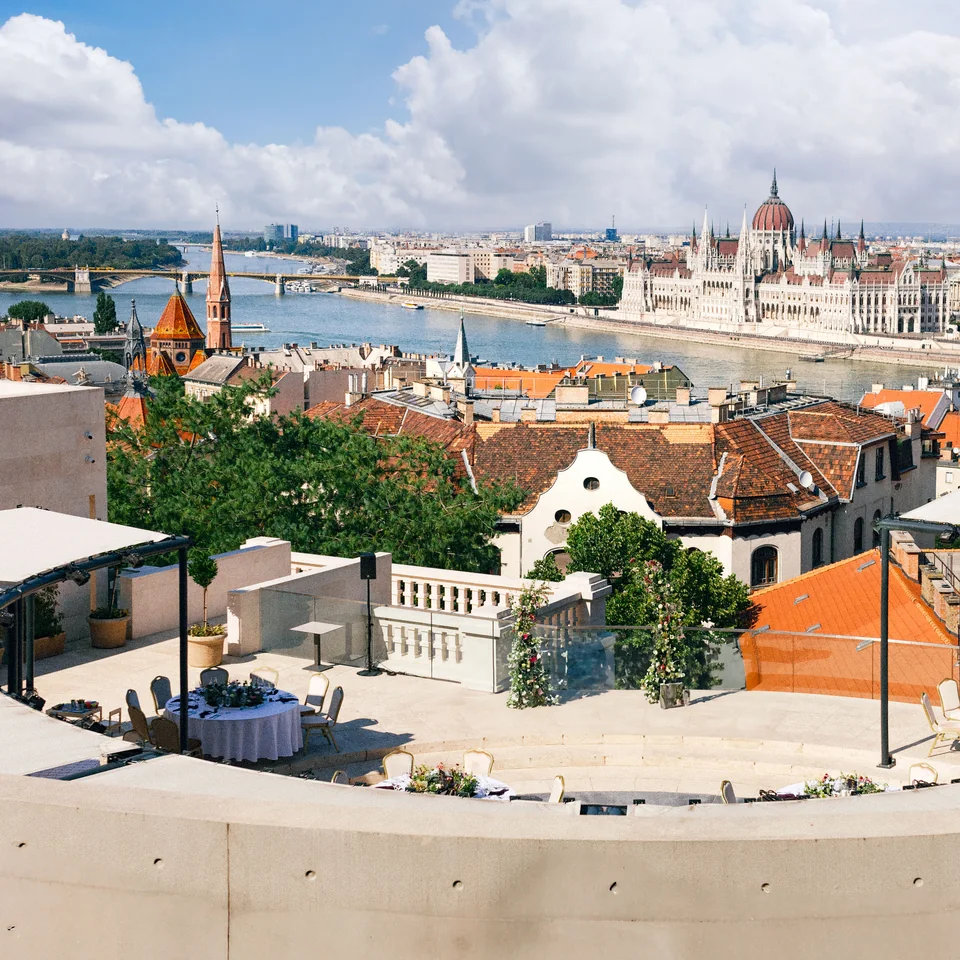
The courtyard takes its name from György Vastagh the Younger’s sculpture of a horseherd restraining his horse. The National Hauszmann Programme records its return to its original position in front of the hall in August 2019, following restoration. The Stöckl Staircase and Hauszmann Ramp connect with the upper Hunyadi Courtyard.
KÖZTI describes Csikós Courtyard and the adjoining Turkish Garden as the setting of the Riding Hall, with new accessible lifts complementing the restored routes. Arrival therefore moves through a sequence of places, revealing the distinctive changes of level on the western side of the palace.
[2][6]08
Hospitality connected to the hall
The current venue website identifies the shared Főőrség and Lovarda catering and event team. Its offer includes seated dinners, standing receptions, Hungarian menus and drinks packages. Basic sound equipment and a microphone are listed as part of the venue, with further lighting, sound and stage equipment available by arrangement.
The celebration can take place in one shared architectural setting. Dinner and music can remain connected to the carved ceiling, galleries and historic detail, allowing the building’s character to continue through the evening programme.
[1]09
A historic form for a present-day celebration
The architectural account published by A Megújulás Kora highlights natural stone, brickwork and substantial timber roof structures. The roof form and arrangement of openings were recreated according to the historic building, while modern building services and event technology were incorporated inside.
This combination gives the venue its wedding identity: a connection to a precisely identifiable Buda Castle building and a setting for a contemporary celebration. An arrangement that brings the existing materials, proportions and details into focus would be particularly suited to this setting. They provide the recognisable sense of place that would be difficult to reproduce in another hall.
[5]PRACTICAL QUESTIONS
A closer look at the details
How large is the hall, and how many wedding guests fit?
The venue states 640 m² and a ceiling height of nearly 15 metres. Guest capacity depends on the layout of tables, dancing and a stage.
[1]Is there a parking connection?
The official website describes a direct Castle Garage connection and a lift to Csikós Courtyard.
[1]When did the roof win its award?
In 2021, in the metal-roof category at the international competition in Marburg. The contemporary official account identifies the reconstructed, elaborately decorated roof of Royal Riding Hall as the winner.
[7]Sources and editorial approach
This guide is an independently written synthesis of the sources below. Venue features and historical facts are grounded in these sources; interpretations of atmosphere and wedding suitability are editorial judgments. Dates, prices, guest numbers and service terms are confirmed in a current proposal from the venue.
- Királyi Lovarda – hivatalos helyszín- és esküvői információk ↗Checked: 2026-11-05
- Nemzeti Hauszmann Program – stratégia, Lovarda fejezet (14–17. oldal) · nemzetihauszmannprogram.huChecked: 2026-11-05
- Budavári Palotanegyed – Lovarda, Csikós udvar és rámpa · info.budavaripalotanegyed.huChecked: 2026-11-05
- PestBuda – helyszíni építészeti bejárás, 2020 · www.pestbuda.huChecked: 2026-11-05
- A Megújulás Kora – Budapest, Királyi Lovarda · www.amegujulaskora.huChecked: 2026-11-05
- KÖZTI – a Főőrség, Királyi Lovarda és környezetük rekonstrukciója · www.kozti.huChecked: 2026-11-05
- Várkapitányság – Budavári Séták,2021november: a Lovarda tetődíja · nemzetihauszmannprogram.huChecked: 2026-11-05
- ÉMSZ – Év Tetője2020,Dr.Birghoffer Péter szakmai elismerése · emsz.huChecked: 2026-11-05
Photo source: Royal Riding Hall